

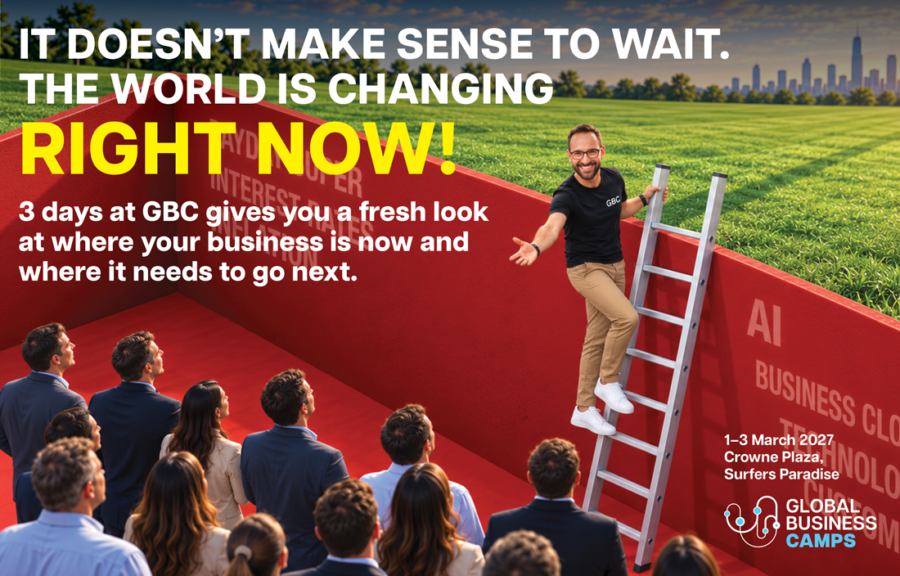
The pace of change isn’t linear anymore – it’s exponential.
Businesses need to move just as fast to stay viable.
There is a phrase I have heard a few times recently.
“I think I’ll wait until the next Global Business Camp.”
I’ve also heard:
“I’ve been before. Do I really need to come again?”
My answer to both is simple…
Look at how much has changed since the last Camp. Then ask yourself how much could change before the next one.
The last Global Business Camp was held in February 2025.
Our next Camp is in March 2027.
And after that?
We don’t know yet. The next Global Business Camp may not be until 2029.
That could mean a four-year gap between Camps for somebody who attended in 2025 and decides to sit this one out.
Four years.
In today’s business environment, that isn’t a gap…
It’s an eternity.
Your business doesn’t get to stand still while you wait
I have worked with SME owners for more than 30 years, and I genuinely believe we are entering one of the most significant periods of business change I have experienced.
Australian businesses are dealing with rising costs, pressure on margins, cash flow challenges, changing employment obligations, increasing regulation, difficulty finding and retaining good people, and customers who are themselves becoming more cautious about where they spend their money.
Even seemingly administrative changes can affect the way a business operates.
From 1 July this year, for example, Payday Super changed the way employers pay superannuation. Instead of the old quarterly cycle, employers now generally need to make super contributions with each pay cycle, with contributions required to reach employees’ funds within seven business days. The ATO’s Small Business Superannuation Clearing House has also permanently closed.
That’s one change.
There are plenty more.
And every new obligation competes for the same things SME owners already don’t have enough of…
Time. Money. People. Attention.
But there is something even bigger happening.
AI is changing the rules while we’re playing the game
Artificial intelligence is not something SMEs need to start thinking about in three or five years.
It is happening now.
Australian SMEs are already adopting AI, and the Federal Government’s National AI Plan describes AI adoption as vital to business success and Australia’s future competitiveness.
But statistics don’t really tell the story.
Look at what businesses can already do with AI that was difficult, expensive or simply impossible for the average SME only a few years ago.
Businesses are using it to analyse information, automate routine work, create content, improve customer service, interrogate data, streamline administration, support decision-making and rethink processes that have existed for years.
And the capability continues to develop at extraordinary speed.
The question for an SME owner is no longer:
“Should I use AI?”
The much more important questions are:
- Where should we use it?
- Where shouldn’t we use it?
- What could it do to our business model?
- What happens to our competitive advantage when everybody has access to capabilities that were once expensive or difficult to obtain?
- What skills will our people need?
- Which systems and processes should we redesign?
And perhaps most importantly:
If our competitors adapt faster than we do, what happens to us?
Doing nothing is still a decision.
It may simply prove to be the wrong one.
That’s why the 2027 Camp is different
When we started putting together the 2027 Global Business Camp, I wanted our presenters to deal with the issues business owners are actually facing.
Not theories.
Not business buzzwords.
What’s happening now, and what SMEs need to do about it.
That’s why Inbal Rodnay will be presenting AI Without the Overwhelm: A Practical Guide for Busy Business Owners.
Inbal works at the intersection of AI and business. Her session isn’t about turning SME owners into technology experts.
It’s about helping you understand what AI means for your business, where the opportunities are and how to approach it practically, so you can start making sensible decisions rather than simply watching the AI revolution happen around you.
But introducing new technology creates another challenge.
Your business can’t take full advantage of AI and automation if the business underneath it is held together by people remembering how everything works.
That’s why David Jenyns, founder of SYSTEMology, is joining us to tackle one of the issues I have spoken about with business owners for decades: systems.
His session, SYSTEMology: Create Time, Reduce Errors, and Scale Your Profits, goes directly to a question every growing SME eventually confronts:
How do we build a business that works consistently without everything depending on the owner?
And that’s only part of the conversation.
Jeremy Khoh will look at how we lead ourselves and our teams as the pace of technological change increases.
Mark Carter will explore value and human capability in the digital age.
Beza Mickan-White will tackle sales strategy and capability for today and tomorrow.
Lisa Kelliher will address another challenge that technology won’t solve for us: giving effective feedback and having the difficult workplace conversations leaders sometimes avoid.
And Michael Cotsios will bring us back to something no business owner can afford to lose sight of through all this disruption: understanding the numbers.
Put all of that alongside the 6 Secrets of Business Success™ and you begin to understand why I believe this particular Camp matters.
We’re not trying to predict the future for you.
We’re giving you three days to prepare your business for it.
“But I came last time”
Good.
Then you already understand what the Global Business Camp is about.
But the 2027 Camp isn’t about repeating what you did in 2025.
Your business isn’t the same business it was in 2025.
- Your numbers have changed.
- Your people may have changed.
- Your customers have changed.
- Your competitors have changed.
- Technology has certainly changed.
- The economy has changed.
And I would be very surprised if your opportunities and risks haven’t changed with them.
Business planning isn’t something you do once and tick off.
You wouldn’t look at your financial statements once every four years.
You wouldn’t review your cash flow once every four years.
So why would you seriously examine the direction, structure and future of your business once every four years?
In fact, given the pace at which things are changing, I think SMEs increasingly need to put their entire business under the microscope every year.
- What worked?
- What didn’t?
- Where are we making money?
- Where are we losing it?
- What has changed around us?
- What should we stop doing?
- What should we start doing?
- What could technology do better?
- Where do our people add the greatest value?
- Where are we vulnerable?
- And where is the next opportunity?
Those are not questions to save for 2029.
Three days can look expensive. Until you consider the alternative.
I understand why business owners hesitate.
- Three days away from the business.
- Flights.
- Accommodation.
- Registration.
- Time.
- There is always something happening back at the office.
But that’s precisely the problem.
There is always something happening back at the office.
And if you never deliberately remove yourself from the noise, the urgent will continue to beat the important.
- Emails get answered.
- Customers get serviced.
- Problems get fixed.
- Payroll gets processed.
- Meetings happen.
- Another week disappears.
- Then another month.
- Then another year.
But who is thinking about where the business needs to be in two years?
- Who is asking whether the way you’ve always done something is still the best way to do it?
- Who is looking for the weaknesses you haven’t noticed yet?
- Who is investigating the opportunities you don’t currently have time to explore?
That’s what the Global Business Camp creates.
Three days to stop.
- Three days to think.
- Three days to question assumptions.
- Three days to look critically at your profitability, cash flow, customers, systems, people, leadership and business value.
- Three days to hear from people who can challenge the way you think about AI, systems, technology, sales, people and the future of your business.
- Three days surrounded by other SME owners and leaders asking many of the same questions.
- And three days to decide what needs to change when you walk back through the door.
I think some SMEs are heading for a rude awakening
I don’t say that to be dramatic.
I say it because the pace of change is becoming increasingly difficult to ignore.
A business can appear healthy today while weaknesses are quietly developing underneath it.
- Margins can erode.
- Costs can creep upwards.
- Key people can leave.
- Customers can change their buying behaviour.
- Technology can make an established process inefficient almost overnight.
- A competitor can find a better way.
- AI can change the economics of work you have performed the same way for years.
- Government can change an obligation or compliance requirement.
And suddenly the business that felt comfortable isn’t quite so comfortable anymore.
Past success is not protection against future change.
In fact, sometimes it creates complacency.
That’s why I believe every SME owner should deliberately put their business under the microscope regularly.
Not when something goes wrong.
Before it does.
Don’t wait for 2029 to discover what you should have changed in 2027
I’ll see you on the Gold Coast.
John Tsoulos
Managing Director
Global Business Camps

